System Architecture & Ingress Pipeline
The NETRA LLM Gateway operates as a non-blocking, tenant-isolated reverse proxy deployed in the critical path between application clients and foundation model providers.
1. High-Level System Architecture
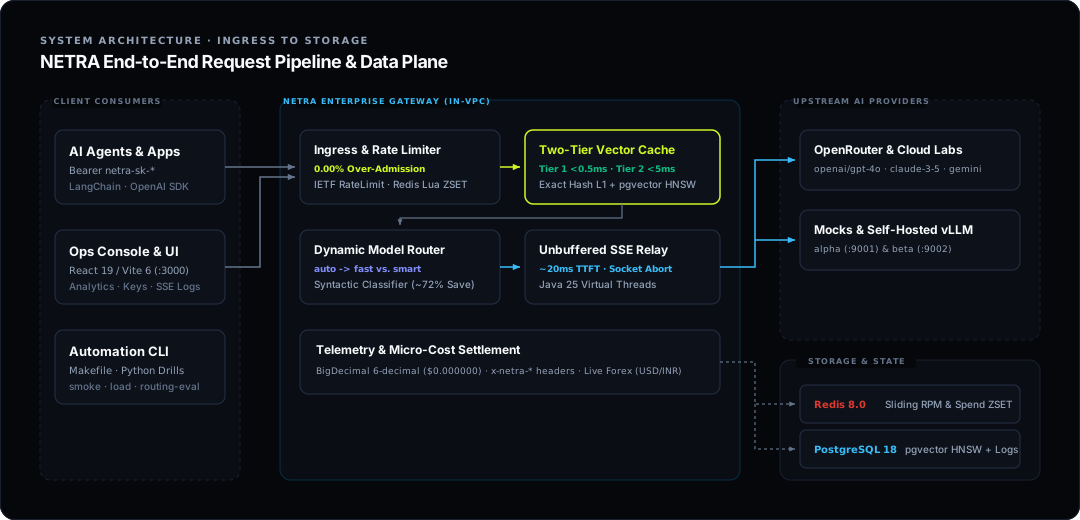
The following diagram illustrates the complete end-to-end request lifecycle through NETRA's data plane, intelligence plane, and backing storage tiers:
2. Ingress Pipeline & Execution Stages
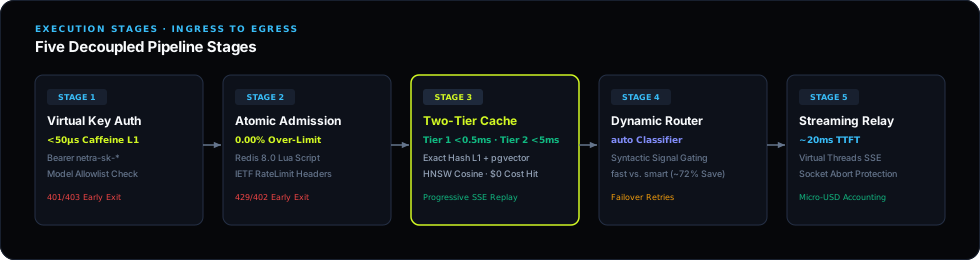
Every incoming HTTP request to POST /v1/chat/completions traverses five decoupled architectural stages:
Stage 1: Virtual Key Authentication & L1 Ingress Cache
- Intercepts all requests via a high-precedence CORS filter (
Ordered.HIGHEST_PRECEDENCE), safely handling cross-origin preflightOPTIONScalls across subdomains (console-*->gateway-*) and exposing allx-netra-*and IETFRateLimit-*headers. - Binds Java 25 Scoped Values for zero-allocation, immutable context propagation across the request lifecycle and child virtual threads.
- Evaluates the incoming HTTP
Authorization: Bearer netra-sk-*header. - Validates the key against an in-memory Caffeine L1 cache (<50μs) to eliminate database read IOPS on the fast path.
- Checks tenant status (
ACTIVE,SUSPENDED,REVOKED) and enforces the tenant's model allowlist. - Rejects unauthenticated or unauthorized requests immediately with HTTP 401 (
invalid_api_key) or HTTP 403 (model_not_allowed).
Stage 2: Atomic Rate Limiting & Budget Admission Control
- Dispatches an atomic Redis 8.0 Lua script.
- Evaluates sliding-window Sorted Set (ZSET) RPM counters and monthly budget spend atomically.
- Guarantees 0.00% over-admission under high-concurrency burst traffic.
- Emits standardized IETF RateLimit headers (
RateLimit-Limit,RateLimit-Remaining,RateLimit-Reset,RateLimit-Policy,Retry-After) compliant withdraft-ietf-httpapi-ratelimit-headersacross all admitted and throttled requests. - If limits are exceeded, returns HTTP 429 (
rate_limit_exceeded) or HTTP 402 (budget_exceeded). - If an upstream network failure occurs later in the request lifecycle, the admitted slot is automatically rolled back via
ZREM.
Stage 3: Two-Tier Tenant-Isolated Semantic Vector Cache
- Tier 1: Canonical SHA-256 Hash Near-Cache (L1 Caffeine + L2 Redis):
- Evaluates deterministic Unicode NFC-normalized prompt SHA-256 hashes.
- Serves exact identical repeat prompts in <0.5ms at $0 compute cost, completely bypassing the ONNX embedding engine (
x-netra-cache-tier: tier1_exact).
- Tier 2: Dense Semantic Vector Cache (pgvector HNSW):
- Generates a 384-dimensional dense vector embedding in ~5ms using an in-process quantized ONNX transformer (
all-MiniLM-L6-v2). - Queries PostgreSQL 18
pgvectorusing the cosine distance operator<=>accelerated by HNSW indexing (m=16, ef_construction=64). - Strictly partitions queries at the SQL level (
WHERE virtual_key = :key AND model_alias = :alias), ensuring complete cryptographic tenant isolation. - If a match meets or exceeds the tenant similarity threshold (e.g., 0.920):
- Returns the cached response in sub-5ms with
$0.000000upstream token cost (x-netra-cache-tier: tier2_semantic). - Automatically back-populates Tier 1 so subsequent exact repeats execute in <0.5ms.
- Replays streaming completions progressively as Server-Sent Events (SSE) ending with
data: [DONE].
- Returns the cached response in sub-5ms with
- Bidirectional Streaming Cache Capture: Upstream SSE token streams are aggregated in real time and automatically ingested into Tier-1 and Tier-2 pgvector caches upon stream completion (supporting
data: [DONE]and clean socket EOF closures). - Upstream safety refusal suppression permanently prevents cache poisoning from guardrail rejections.
- Generates a 384-dimensional dense vector embedding in ~5ms using an in-process quantized ONNX transformer (
Stage 4: Intelligent Model Routing, Circuit Breakers & Auto-Escalation
- Resolves model aliases (
fast,smart,auto) or direct model identifiers. - For
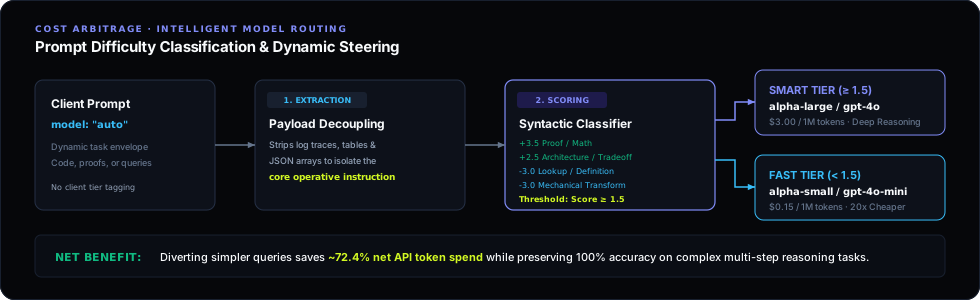
model: "auto":- Invokes the two-stage syntactic difficulty classifier.
- Decouples task instructions from data payloads and scores grammatical complexity signals in <0.2ms.
- Steers simple queries to
fastmodels and complex reasoning tasks tosmartmodels, achieving ~72.4% cost savings.
- Resilience4j Circuit Breakers & Candidate Chain Failover:
- Each upstream provider is guarded by an autonomous Resilience4j circuit breaker (sliding window of 20 calls, minimum 5 calls, 50% failure rate threshold, 10s cooldown).
- When a provider trips to OPEN, incoming requests fast-failover to partner providers in <0.05ms without making a network hop.
- Enforces bounded exponential backoff retries and a strict total candidate chain deadline budget (
maxChainTimeoutMs: 15000ms), preventing edge proxy timeouts. - Telemetry and circuit states are continuously exposed via
GET /admin/providers/healthand the Ops Console.
- Small-Model Refusal & Degradation Auto-Escalation Engine:
- Inspects responses from cheap/small models (
alpha-small,beta-small,fast) for refusal markers or apologies. - Seamlessly auto-escalates refused prompts to the high-capability frontier tier (
smart/alpha-large), emittingx-netra-escalated: true.
- Inspects responses from cheap/small models (
Stage 5: Unbuffered Streaming Relay & Financial Ledger
- Streams token deltas to clients over Java 25 Virtual Threads using unbuffered Server-Sent Events (~20ms Time-to-First-Token).
- Disconnect Protection & Token Reclamation: Detects client disconnections (
Broken pipe) immediately and halts upstream compute within <2ms to eliminate phantom spend. If the client disconnects before tokens are generated (0 tokens), the admitted sliding-window rate limit slot is automatically rolled back via atomic RedisZREM, preventing quota starvation caused by client drops. - On stream completion, captures token counts and computes exact micro-USD costs using 6-decimal
BigDecimalprecision. - Writes structured audit records to PostgreSQL asynchronously via a decoupled 10,000-capacity bounded batch buffer, flushing multi-row inserts and aggregated multi-tenant spend every 250ms or 100 entries to completely shield the underlying database connection pool.
3. Architecture Decision Records (ADRs)
For formal engineering decisions, architectural context, evaluated trade-offs, and design rationale across all components, explore the complete Architecture Decision Records (ADRs).